

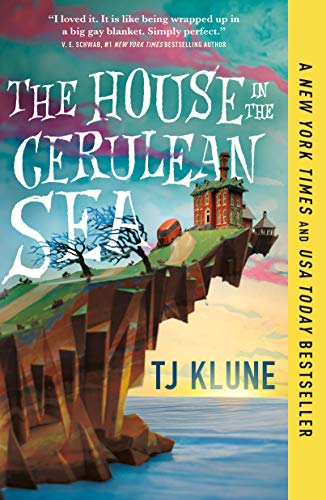
New York : Tor, A Tom Doherty Associates Book 2020
398 pages
ISBN 978-1-250-21731-8
In December Donostia Book Club reads a novel that can be enjoyed both by teenagers and adults, The House in Cerulean Sea. A tender fantasy fiction opens with a not so tender image of the world where innocent children with magical skills are chased and locked in special facilities, separated from society.
Published in 2020 the novel caused quite a commotion: on one hand it was praised for the maestry of style and causing pure feeling of joy in its readers, on the other the author was said to be inspired by Canada’s residential schools, and in particular, a cultural genocide tactic called “the 60s scoop” and that caused some controversies. Our protagonist is Linus Baker who for the last 17 years has been working in the Department in Charge of Magical Youth. A model worker who never asks questions, does what he’s told to do and assumes his superiors are doing the right thing. But… are they? Once Linus is sent to the secluded orphanage where Arthur Parnassus takes care of six children considered highly dangerous by the Department, Linus starts questioning if his work is really just and focused on protecting society.
The novel is a perfect example of how fantasy can be used as a social critique tool. It gives us feel good vibes, but the story is darker than it might seem while reading it. It focuses on topics of tolerance, fear, cultural prejudices, discrimination… And all that with the trope of the found family forefront.
The novel being a fantasy story won’t be liked by all, genre books still tend to cause some unjust rejection as simple or of lower category. Also, not everyone enjoys the elements of magic. But those who can look past these things will definitely find a complex story with characters that make us wonder about how one can make the world a bit more just.
For those of you who would like to participate in our book club meeting on December 1st or to analyse the book on your own, here are some questions prepared by the publisher, TOR:
- As an employee of DICOMY, Linus Baker works under very rigid rules
  and regulations (and that’s literally the name of the handbook he refers
  to quite often!). He’s constantly being monitored, yet he still manages
  to produce quality work. Why does he push through working under
  such pressure? And if you were in his shoes, would you be able to
  work under those conditions?
- Linus is a very lonely man and prior to investigating the Marsyas
  Island Orphanage, his only friend and family is his aloof cat Calliope.
  While building a family and a home becomes important for Linus as
  the story progresses, why wasn’t this a priority in his past? Why is he
  so isolated as an adult, and do you think this can this be attributed to
  what his home life was like growing up?
- This book is thoroughly endearing, and part of the reason is because
  of the children! They each have such unique and incredible powers.
  Whose magical abilities appeal to you most? If you were to choose
  your own magical powers, what would they be and why?
- Linus and Lucy bond over their love of music, and artists such as
  The Everly Brothers, Sam Cooke, Bobby Darin, The Coasters,
  Little Richard, The Big Bopper, and Buddy Holly are frequently
  mentioned. Why is music such a large part of the story?
  What role does it play in the characters’ lives?
- Let’s talk about Chauncey! He’s such a loveable and sweet
  character. It’s clear he wants to grow up and help people.
  While there are many professions in which people help others
  (like doctors or firefighters), what about the prospect of being a
  bellhop specifically entices him so much?
- Each of the characters in this book have different fears to work
  through and conquer. Arthur fears for the safety and wellbeing of
  the children. Linus fears stepping out of his comfort zone and truly
  being seen. The villagers fear the magical powers the children
  possess—and that fear manifests into hate. Do you think the
  characters face their fears in beneficial ways? How do you deal
  with your fears? Do you feel you can relate to any of the
  characters’ ways of coping?
- Body size is mentioned quite often throughout the book. Linus
  always attempts to shrink himself—both literally and figuratively.
  Can you explain the dichotomy between him being a larger person,
  yet seeming to take up little or no space? And how does size have
  an impact on the story overall?
- Lucy suffers from terrible nightmares. He says that in these
  nightmares he has spiders on the brain. His night terrors are so bad
  that his bedroom is actually the closet off of Arthur’s room. Do you
  think Lucy sleeping so close to Arthur is a good idea, or does it
  prevent him from being more independent like the other children?
  Does it show favoritism in any way? Why does he suffer from such
  terrible nightmares?
- The townspeople who live near the Marsyas Island live in fear of the
  six children in the orphanage. Why do you think that is? Where does
  prejudice come from? Why do people fear the unknown?
  At the heart of the novel is the importance of surrounding yourself with
  people who feel like home and finding a place where you wholeheartedly
  belong. How do you personally define “home?” What are the essentials?

Taken from:
https://images.macmillan.com/folio-assets/readers-guides/9781250217288RG.pdf
|