

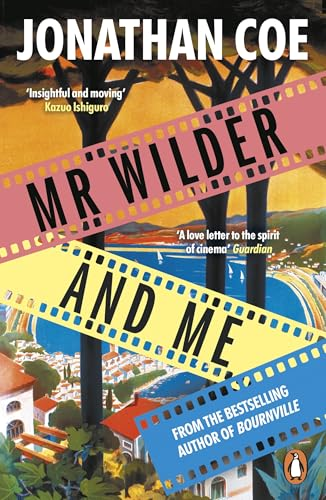
Over a year ago, in April 2025, we could enjoy the meeting with Jonathan Coe organised by Literaktum Topaketak. This month, in Donostia Book Club we have decided to revisit his novel Mr Wilder and Me, called by The Guardian “the renaissance of Jonathan Coe”.
First published in the UK on 5 November 2020, the book is a historical fiction work that intertwines the coming-of-age story of a young Greek interpreter, Calista Frangopoulou, with the late career of legendary Hollywood director Billy Wilder. The story alternates between Calista’s present-day crisis in London, where she struggles with her career as a composer of film scores and some family crisis, and her 1976–1977 flashbacks, where she is hired on the film set of Fedora and observes how Wilder and his writing partner I.A.L. Diamond work.
The wonderful blend of real figures and invented characters perfectly transmits Coe’s fascination for both Wilder and his films. On his website Coe says: “I discovered Billy Wilder’s films in the late 1970s, when I was a teenager. But the first film of his that I saw (on television) was not one of his acknowledged masterpieces – such as Double Indemnity, Sunset Boulevard or Some Like It Hot – but The Private Life of Sherlock Holmes, his reimagining of the great detective’s personal life, which had been a commercial and critical flop. I’ve written elsewhere about how my love for this film developed into a full-blown obsession. (…) So I have always wanted to write a book about Billy Wilder.” This obsession he mentions turned into a novel that explores themes of fame, nostalgia, and creativity, but also shows Wilder confronting Holocaust denial and his traumatic history fleeing Nazi Germany.
Weyou’ll join us at our meeting on 13 April 2026, where we will definitely talk about some of these questions:
– How did the tone—nostalgic, reflective, sometimes melancholic—affect your reading experience?
– How did you perceive Calista Frangopoulou as a narrator? Did you find her reliable and engaging?
– What makes Billy Wilder such a compelling presence in the novel, even late in his career?
– The novel explores aging and late creativity—how does Billy Wilder’s situation reflect this theme? And Calista’s?
– How does the book portray the tension between artistic vision and commercial reality?
– What does the story say about nostalgia—both personal and cultural?
– How are gender dynamics and power structures in the film industry depicted?
– In what ways does the novel explore the idea of “missed opportunities” or roads not taken?
– How important is the 1970s setting to the story? Could it work in another era?
– What role does the European backdrop (especially Greece) play in shaping the narrative?
– How does the historical context of filmmaking during this period influence the plot?
– What do you think about the framing device—Calista recounting events years later?
– How does the pacing of the novel reflect the process of filmmaking?
– Did the mix of fiction with real historical figures enhance or distract from the story?
– How does Calista’s perspective on her younger self change over time?
– Is the novel more about Billy Wilder, or about Calista’s coming-of-age? Why?