

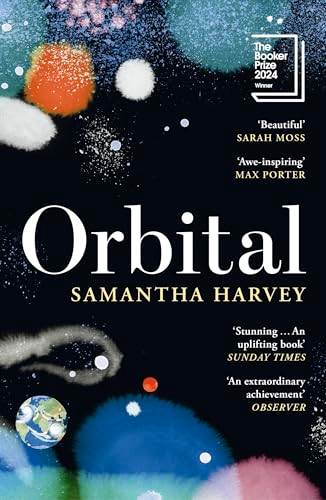
At Donostia Book Club, we start the year by discussing Samantha Harvey‘s novel Orbital. Published in 2023, it won the 2024 Booker Prize and stands out for its original subject matter and the way it is handled in such a brief space. The author tells us about four astronauts and two cosmonauts on the International Space Station. I say ‘tells us things’ because we don’t see their entire stay, nor their complete past, nor do we know anything about their future. We have images, scenes, random thoughts, connected by the fact that they are all in low Earth orbit at the same time. That is why some people question whether this book can be considered a novel: as it has no plot, it deviates from the typical structure of this literary genre.
If I had to sum it up in one sentence, I would say that it is a book about the very intimate perception of the greatness of the universe, the vertigo that direct contact with something infinite can cause, and the ways in which we can continue to be individuals despite everything. Each of the characters we meet is experiencing, at the moment we see them, almost the same things. They see the same things, they are in the same space. But their inner worlds are affected by their past, by their desires, by the news they receive from Earth. The complexity of life as something common, but at the same time something so intrinsic, is reflected in the rich images Harvey conveys to us. The author’s prose is both lyrical and vivid, the best experience a reader could imagine.
A book that in just 200 pages mixes the personal, the scientific and the metaphysical will surely give us a lot to talk about. On 12 January, among other issues, we will try to answer the following questions:
- In a recent interview with the Booker Prizes, Samantha Harvey said
  she ‘wanted to write about our human occupation of low earth orbit
  for the last quarter of a century – not as sci-fi but as realism’.
  In doing so, Harvey wondered if she could ‘evoke the beauty of that
  vantage point with the care of a nature writer’. Do you think she
  succeeded in this approach? How does her depiction of space
  travel compare to both traditional sci-fi and nature writing?

- Orbital takes place over a single day, a Tuesday in October. During
  the course of that day, the craft orbits Earth 16 times. How does the
  author use the concept of time to structure the narrative? What effect
  does this one-day snapshot have on the reader’s understanding of the
  characters’ experiences and the sense of time in space?

- Harvey frequently uses metaphor throughout the novel. How does
  her use of these devices enhance the reader’s ability to visualise
  the astronauts’ experience? Does it make these extraordinary,
  otherworldly events more relatable?

- Throughout the novel, Harvey makes several implicit references to
  climate change.  Discuss how such references function as part of
  the subtext of the novel.

- The novel contrasts the astronauts’ cyclical, repetitive day-to-day
  activities in space, such as exercise, sustenance, maintenance and
  chores; with the vast, dynamic life on Earth below. How does Harvey
  use this juxtaposition of perspective to balance the novel and explore
  the relationship between the micro (the astronauts’ world) and the
  macro (the billions of lives on Earth)?

- In a review for The New Yorker, James Wood writes that ‘Orbital is
  the strangest and most magical of projects, not least because it’s
  barely what most people would call a novel but performs the kind
  of task that only a novel could dare. It’s barely a novel because it
  barely tells a plotted set of human stories, and the stories it does
  tell barely interact with one another.’ Do you agree Orbital is
  ‘barely a novel’? Discuss the absence of conventional plot and
  how this affects the reading experience. And if it’s not really a
  novel, what is it?

- Orbital contains numerous references to past events in the
  lives of the astronauts. How do these references shape our
  impression of the characters, and enhance the novel’s depth?
  Would it have been a different novel without these backstories?

- Harvey’s prose is often repetitive and looping, and deployed
  with a rhythmic style. How does this impact the reader’s
  experience and the novel’s overall tone?

- Harvey’s work has drawn comparisons to Virginia Woolf from
  both readers and critics. In a recent interview with the Guardian,
  she said, ‘I admire Woolf probably more than any other writer
  I can think of. I didn’t think about parallels with The Waves
  while writing Orbital, but I can see there’s something [similar]
  about the way voices surface and dissipate. If the influence
  was there, it wasn’t conscious.’ In your reading of the novel,
  do you see similarities between Harvey’s work and that of Woolf?

- Orbital touches on themes of religion, meaning and existentialism,
  as the astronauts grapple with their place in the universe while
observing Earth from above. How does Harvey explore these big
  themes, within the context of their confinement? In what ways
  does the characters’ isolation amplify such existential questions?

Questions taken from:
https://thebookerprizes.com/the-booker-library/features/reading-guide-orbital-by-samantha-harvey
|