

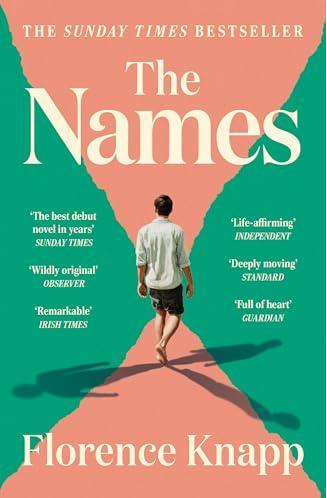
London: Phoenix Books, 2025
344 pages
9781399624046
What would your life have looked like if you had been given a different name? That is the question behind The Names, the debut novel by Florence Knapp, published in spring 2025. It has since been translated into more than twenty languages, was a Read with Jenna pick, and was included by the BBC among the 25 best books of 2025. At Donostia Book Club we wanted to find out whether a book surrounded by so much word of mouth lives up to it, so The Names is our reading for our meeting on December, 10th.
It is October 1987, the day after the Great Storm that swept across southern England. Cora, a mother of two, walks through fallen trees with her nine-year-old daughter Maia to register the birth of her newborn son. Her violent husband Gordon wants the boy to carry his own name; Maia would rather call him Bear, a name that sounds soft, kind and brave; and Cora herself prefers Julian, which means “sky father”. From the registry office the novel splits into three timelines, one for each name, and follows the boy, Cora and Maia in seven-year leaps until 2022, when he is thirty-five. In one version Cora and her children are largely free of Gordon, in another they are raised in Ireland by Cora’s mother Sílbhe, and in the third they remain under the father’s control. Knapp, who has said she is more fascinated by “the subconscious associations” we bring to names than by their dictionary meanings, ends the book with a glossary of what each name in the story signifies.
Critics were quick to praise both the ambition of the structure and the care with which it handles its subject. The Observer’s Ellen Peirson-Hagger wrote that it “may well be the most devastating book you read this year”, while The Washington Post’s Elizabeth Hand called it “a profound, deeply compassionate examination of domestic abuse”. Publishers Weekly and Kirkus Reviews both gave it starred reviews, and comparisons with Kate Atkinson’s Life After Life and the film Sliding Doors appeared from the start. It is a novel about what a name might change, and about everything it cannot: violence, fear and love are present in every version, and so is Maia, a constant in all three. Please bear in mind that domestic abuse is at the centre of the story.
We hope you’ll join us at our meeting, where we will definitely talk about some of these questions (please note that some of them contain spoilers regarding the plot):
• The novel splits into three timelines at the registry office and then rotates between Bear, Julian and Gordon. How did you experience that structure? Did you keep the three versions apart easily, or did you find yourself comparing them chapter by chapter?
• Each timeline jumps forward seven years at a time, from 1987 to 2022. What does this rhythm do to the story, and which year or section hit you hardest?
• Do you think a name can shape who we become, through what others expect of us and what we expect of ourselves? Or is it just a label we fill with our own meaning? What did the glossary at the end of the book add to your reading?
• Cora chooses the name under pressure, and each choice carries a different risk. How did you judge her decision in each version? Is there a “right” name, or does the real difference lie elsewhere?
• Bear, Julian and Gordon all fear they have inherited their father’s violence. What do we inherit from our families, and what from the names we are given?
• Gordon senior is a menacing figure in all three timelines. How does Knapp portray domestic abuse and coercive control? Did the book handle the subject with the care it deserves?
• Maia is present in all three stories. What does her path tell us about how the home environment shapes the freedom to be oneself?
• The novel moves between England and Ireland, and between three generations of women: Sílbhe, Cora and Maia. What role do family, place and female support play in each version?
• Every timeline ends with some kind of hope. Did you find those endings satisfying? Did any version feel more believable than the others, or perhaps too optimistic?
• How does The Names compare with other what-if or parallel-lives novels you have read? What does Knapp do differently?
• Which version of the boy would you have liked to follow for longer, and which one stayed with you the most? And finally, do you like your own name? Have you ever wondered what your life would have been like with another?