

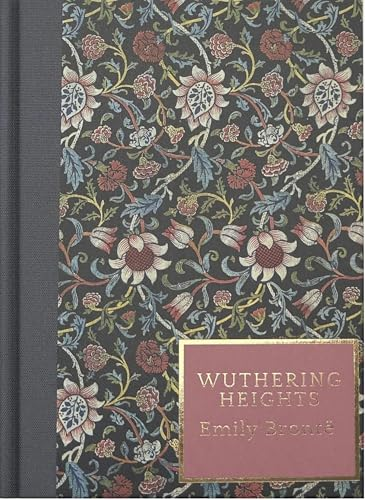
A few months ago, the new film adaptation of Wuthering Heights caused quite a stir. Emerald Fennell’s interpretation differs significantly from the book, and the director herself described it as a sort of fan fiction. At Donostia Book Club, we decided to take a closer look at the original and chose Emily Brontë’s celebrated classic as our reading for the meeting on 11 May.
In December 1847, Emily Brontë’s only published novel burst onto the English literary scene, shocking both the public and the critics with its raw depictions of violence and psychological abuse. A critic in Douglas Jerrold’s Weekly Newspaper wrote indignantly: “The reader is … disgusted, almost sickened by details of cruelty, inhumanity, and the most diabolical hate and vengeance.” Another critic noted, “There is not in the entire dramatis persona a single character which is not utterly hateful or thoroughly contemptible.” One word in particular dominated these critiques: “coarse.” Even so, beneath this scrutiny, one could sense a grudging admiration for the novel’s sheer power. As the man from Douglas Jerrold’s himself pointed out: “It is impossible to begin and not finish it; and quite as impossible to lay it aside afterwards and say nothing about it.”
Wuthering Heights stands out from other novels of the period for its dramatic and poetic style, the complete absence of commentary from the author, and its unusual structure. It recounts, through the retrospective account of a witness—which in turn includes shorter narratives—the impact that the orphan Heathcliff had on the two families, the Earnshaws and the Lintons, in a remote part of Yorkshire in the late 18th century. Bitter over the mistreatment he suffered and over the marriage of Cathy Earnshaw—who shares his tempestuous temperament and whom he loves—to the gentle and prosperous Edgar Linton, Heathcliff plots revenge against both families, extending his vendetta into the second generation. Cathy’s death in childbirth fails to free him from his love-hate relationship with her, and his obsessive fixation persists until his own death; the marriage of the surviving heirs of the Earnshaws and the Lintons restores peace. The story is raw, full of injustice and cruelty, yet at the same time it does not shy away from the issues that many at the time preferred to keep silent: the absolute dependence of women, domestic abuse, class inequality, poverty, classism. And all of this is set against the harrowing backdrop of the desolate and isolated moors of Yorkshire.
Our discussion certainly didn’t manage to cover everything Emily Brontë’s novel has to offer, but in our best attempt to examine all the details, we talked about the following points:
– To what extent do you think the setting of the novel contributes to, or informs, what takes place? Do you think the moors are a character in their own right? How do you interpret Bronte’s view of nature and the landscape?
– Do you think the novel is a tale of redemption, despair, or both? Discuss the novel’s meaning to you. Do you think the novel’s moral content dictates one choice over the other?
– Discuss Bronte’s use of twos: Wuthering Heights and Thrushcross Grange; two families, each with two children; two couples (Catherine and Edgar, and Heathcliff and Isabella); two narrators; the doubling-up of names. What is Bronte’s intention here? Discuss.
– How do Mr. Lockwood and Nelly Dean influence the story as narrators? Do you think they are completely reliable observers? What does Bronte want us to believe?
– Discuss the role of women in Wuthering Heights. Is their depiction typical of Bronte’s time, or not? Do you think Bronte’s characterizations of women mark her as a pioneer ahead of her time or not?
– Who or what does Heathcliff represent in the novel? Is he a force of evil or a victim of it? How important is the role of class in the novel, particularly as it relates to Heathcliff and his life?
– Do you think Bronte succeeds in creating three-dimensional figures in Heathcliff and Cathy, particularly given their larger-than-life metaphysical passion? Why or why not?
(The source of the quesions: https://bookclubs.com/discussion-guides/wuthering-heights-penguin-classics )